Scooby-Doo informationThe Scooby influence
Nevertheless, Scooby-Doo has maintained a significant fan base, which has grown steadily since the 1990s due to the show's popularity among both young children and nostalgic adults who grew up with the series. The show's mix of the comedy-adventure and horror genres is often noted as the reason for its widespread success. As Fred Silverman and the Hanna-Barbera staff had planned when they first began producing the series, Scooby-Doo's ghosts, monsters, and spooky locales tend more towards humor than horror, making them easily accessible to younger children. "Overall, [Scooby-Doo is] just not a show that is going to overstimulate kids' emotions and tensions," offered American Center for Children and Media executive director David Kleeman in a 2002 interview. "It creates just enough fun to make it fun without getting them worried or giving them nightmares." Many teenage and young adult audiences enjoy Scooby-Doo because of presumed subversive themes which involve theories of drug use and sexuality. In recent years, Scooby-Doo has received recognition for its popularity by placing in a number of "top cartoon" or "top cartoon character" polls. The August 3, 2002 issue of TV Guide featured its list of the "50 Greatest Cartoon Characters of All Time", in which Scooby-Doo placed twenty-second[21] Scooby also ranked thirteenth in Animal Planet's list of the "50 Greatest TV Animals". Scooby-Doo, Where Are You! ranked forty-ninth in the UK network Channel 4's 2005 list of the "100 Greatest Cartoons of All Time". For one year from 2004 to 2005, Scooby-Doo held the Guinness World Record for having the most episodes of any animated television series ever produced, a record previously held by and later returned to The Simpsons. Scooby-Doo was published as holding this record in the 2006 edition of the Guinness Book of Records.
Assumed "adult themes" Drug use is the most prominent of these charges, in particular because of Shaggy's beatnik origins. He and Scooby-Doo are shown to have voracious appetites, which has been interpreted as being evidence of a case of "the munchies" resulting from marijuana use. It is also believed that Shaggy and Scooby Doo's perpetual state of paranoia during mystery investigations, in contrast to the calm demeanor displayed by the other lead characters, is due to marijuana use. Some parodies go on to propose that the "Scooby Snacks" present in many episodes contain drugs instead of typical dog treat ingredients. The most direct references to the Scooby-Doo drug use theory were produced by Warner Bros. and Cartoon Network themselves. The first live action Scooby-Doo film makes several joking references to Shaggy and Scooby's purported drug use and even has Shaggy fall in love with a girl named "Mary Jane" (a common slang term for marijuana) and an early scene of smoke coming out of a vent in the roof of the van (but then showing it's just steam from their cooking), while an episode of the Adult Swim cartoon Harvey Birdman, Attorney at Law finds Shaggy and Scooby-Doo arrested for possession of marijuana.
Another debated topic of the series centers around whether or not the tomboyish Velma is a lesbian. (Indeed, the character was based on the Dobie Gillis character Zelda, played by Sheila Kuehl – who later revealed her homosexuality.) The character has a considerable fan base among real-life lesbians, who see her as one of their own. The idea of Velma as a lesbian is parodied in the 2001 motion picture Jay and Silent Bob Strike Back, the "¡Viva los Muertos!" episode of The Venture Bros. (which featured a caricature of radical feminist and would-be Andy Warhol assassin Valerie Solanas as the Velma character), as well as both Scooby-Doo live-action films. Many, but not all, of the lesbian-themed gags from the first Scooby-Doo film, which center around a hinted crush Velma has on Daphne in the film, were excised from the final release print to secure a PG rating. Other early Scooby-Doo merchandise included a 1973 Milton Bradley board game, decorated lunch boxes, iron-on transfers, coloring books, story books, records, underwear, and other such goods. When Scrappy-Doo was introduced to the series in 1979, he, Scooby, and Shaggy became the sole foci of much of the merchandising, including a 1983 Milton-Bradley Scooby-Doo and Scrappy-Doo board game. The first Scooby-Doo video game appeared in arcades in 1986, and has been followed by a number of games for both home consoles and personal computers. Scooby-Doo multivitamins also debuted at this time, and have been manufactured by Bayer since 2001. Scooby-Doo merchandising tapered off during the late 1980s and early 1990s, but increased after the series' revival on Cartoon Network in 1995. Today, all manner of Scooby-Doo-branded products are available for purchase, including Scooby-Doo breakfast cereal, plush toys, action figures, car decorations, and much more. Real "Scooby Snacks" dog treats are produced by Del Monte Pet Products. Hasbro has created a number of Scooby board games, including a Scooby-themed edition of the popular mystery board game Clue. From 1990 to 2002, Shaggy and Scooby-Doo appeared as characters
in the Funtastic World of Hanna-Barbera simulator ride at Universal
Studios Florida. The ride was replaced in the early 2000s
with a Jimmy Neutron attraction, and The Funtastic World of Hanna-Barbera
instead became an attraction at several properties operated by
Paramount Parks. Shaggy and Scooby-Doo are costumed characters
at Universal Studios Florida, and can be seen driving the Mystery
Machine around the park. |
    |
|||||||||
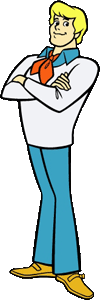 Like many Hanna-Barbera shows, Scooby-Doo was criticized for
poor production values and formulaic storytelling. In 2002,
Jamie Malanowski of The New York Times commented that "[Scooby-Doo's]
mysteries are not very mysterious, and the humor is hardly
humorous. As for the animation -- well, the drawings on your
refrigerator may give it competition." Even proponents
of the series often comment negatively about the formula inherent
in most Scooby episodes. Science advocate Carl Sagan, however,
favorably compared the formula to that of most television dealing
with paranormal themes, and considered that an adult analogue
to Scooby-Doo would be a great public service.
Like many Hanna-Barbera shows, Scooby-Doo was criticized for
poor production values and formulaic storytelling. In 2002,
Jamie Malanowski of The New York Times commented that "[Scooby-Doo's]
mysteries are not very mysterious, and the humor is hardly
humorous. As for the animation -- well, the drawings on your
refrigerator may give it competition." Even proponents
of the series often comment negatively about the formula inherent
in most Scooby episodes. Science advocate Carl Sagan, however,
favorably compared the formula to that of most television dealing
with paranormal themes, and considered that an adult analogue
to Scooby-Doo would be a great public service.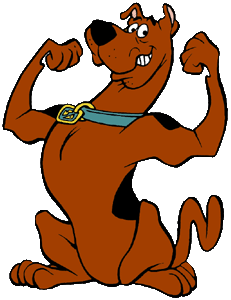 Subsequent television shows and films often make reference to
Scooby-Doo, for example Wayne's World and the television series
Buffy the Vampire Slayer, in which Buffy and her monster-slaying
friends refer to themselves as the "Scooby Gang" or "Scoobies," a
knowing reference to Scooby-Doo. (Coincidentally, Sarah Michelle
Gellar, who played Buffy, later played Daphne in the live-action
movies). Even South Park paid homage to Scooby-Doo in an episode
entitled "KoЯn's Groovy Pirate Ghost Mystery".
The Kevin Smith film Jay and Silent Bob Strike Back included
a scene where Jay and Silent Bob are picked up in the Mystery
Machine while hitchhiking and both they and Mystery, Inc. get "high" off
of "dooby snacks". A plethora of other media properties
have referenced or parodied Scooby-Doo, among them the TV Funhouse
segment of NBC's Saturday Night Live , the online comic Sluggy
Freelance, the FOX animated series Family Guy and The Simpsons,
and the Cartoon Network programs Johnny Bravo, The Grim Adventures
of Billy & Mandy, Harvey Birdman, Attorney at Law and The
Venture Bros.
Subsequent television shows and films often make reference to
Scooby-Doo, for example Wayne's World and the television series
Buffy the Vampire Slayer, in which Buffy and her monster-slaying
friends refer to themselves as the "Scooby Gang" or "Scoobies," a
knowing reference to Scooby-Doo. (Coincidentally, Sarah Michelle
Gellar, who played Buffy, later played Daphne in the live-action
movies). Even South Park paid homage to Scooby-Doo in an episode
entitled "KoЯn's Groovy Pirate Ghost Mystery".
The Kevin Smith film Jay and Silent Bob Strike Back included
a scene where Jay and Silent Bob are picked up in the Mystery
Machine while hitchhiking and both they and Mystery, Inc. get "high" off
of "dooby snacks". A plethora of other media properties
have referenced or parodied Scooby-Doo, among them the TV Funhouse
segment of NBC's Saturday Night Live , the online comic Sluggy
Freelance, the FOX animated series Family Guy and The Simpsons,
and the Cartoon Network programs Johnny Bravo, The Grim Adventures
of Billy & Mandy, Harvey Birdman, Attorney at Law and The
Venture Bros.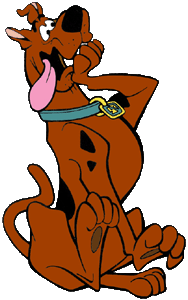 Also discussed and parodied are the presumed sexual activities
going on among the Scooby-Doo characters. While working on the
original series, Joe Ruby and Ken Spears often wrote their "straight
men", Fred and Daphne, out of the episode so that they could
focus on their "comedians": Shaggy, Scooby, and Velma.
As a result, Fred and Daphne are missing from a significant amount
of the action in most episodes, leading to assumptions that the
two are off having sex instead of finding clues. Like the
drug use, this assumed theme has also been self-parodied, with
the "Bravo Dooby Doo" episode of Johnny Bravo, and
both live-action and direct-to-video Scooby-Doo features making
light of Fred and Daphne's presumed sexual relationship.
Also discussed and parodied are the presumed sexual activities
going on among the Scooby-Doo characters. While working on the
original series, Joe Ruby and Ken Spears often wrote their "straight
men", Fred and Daphne, out of the episode so that they could
focus on their "comedians": Shaggy, Scooby, and Velma.
As a result, Fred and Daphne are missing from a significant amount
of the action in most episodes, leading to assumptions that the
two are off having sex instead of finding clues. Like the
drug use, this assumed theme has also been self-parodied, with
the "Bravo Dooby Doo" episode of Johnny Bravo, and
both live-action and direct-to-video Scooby-Doo features making
light of Fred and Daphne's presumed sexual relationship.


© Cartoon Watcher .com All Rights Reserved. Scooby-Doo website design created by Cartoon Watcher.
"Scooby-Doo website" by no means tries to pass itself off as the official Scooby Doo website.
All trademarks and copyrights on this page are owned by their respective owners.

